From my own experiences, I have had both successes and faced many challenges in “breaking code” in order to access, use and understand digital spaces mainly through the use of different social media platforms. When I first got Facebook it was a requirement for my grade nine English class. We used it as a “media” component that was being introduced into the curriculum and my class was a test run. I found code breaking challenging at first. Code breaking was difficult trying to figure out the symbols and different functions associated with Facebook. Across different social media platforms, the symbols for the same identifiers differ making it more difficult to learn and code break. An example of this is the message icon on both Facebook and Instagram are very different. The symbols were not cross-cultural or translate across platforms. In relation to emoji’s, there are emoji’s that do not carry over or are represented in the same way. This disjunction can lead to miscommunications in many forms. An example is when texting the use of emoji’s can be misinterpreted as each person understand the emotions and meanings of the emoji’s differently. The context of the emoji can also change depending on the text. And the difference between Android and Apple emoji’s I have found have been to be problematic. On an Android, the emoji may come across as a smirk but on the Apple, it is a confused face. As well, with the advances in texting abbreviations and slang have changed literacy and the way people effectively communicate with each other. “‘Texting’ involves new forms of vocabulary and grammar as well as new practices relating to time and space (status updates and conversational text, for example). Digital texts are, or have become, predominantly multi-modal (e.g. graphical user interfaces are the norm, context sensitivity is driven by ‘spatial’ visual cues [1] i.e. the position of a cursor determines the result of a mouse click)” (Hinrichsen and Coombs).
Integrating digital literacy into current learning environments where code breaking is required could be done in a way where students use e-books or reading online blogs or journals. I could support others especially students by demonstrating the way in which to use the electronic resources and by allowing the student to ask questions and show them the answers. The use of games and interactive online materials would be very beneficial in doing this. When introducing web and electronic resources allowing students to be able to experiment with the resource is very crucial in the learning process in my opinion. From my own learning experiences, the process of trial and error has greatly shaped my learning experience. To improve my ability to decode digital spaces effectively I could use the spaces regularly and experiment with different parts of the resources and watch videos that explain the different components of the digital space.
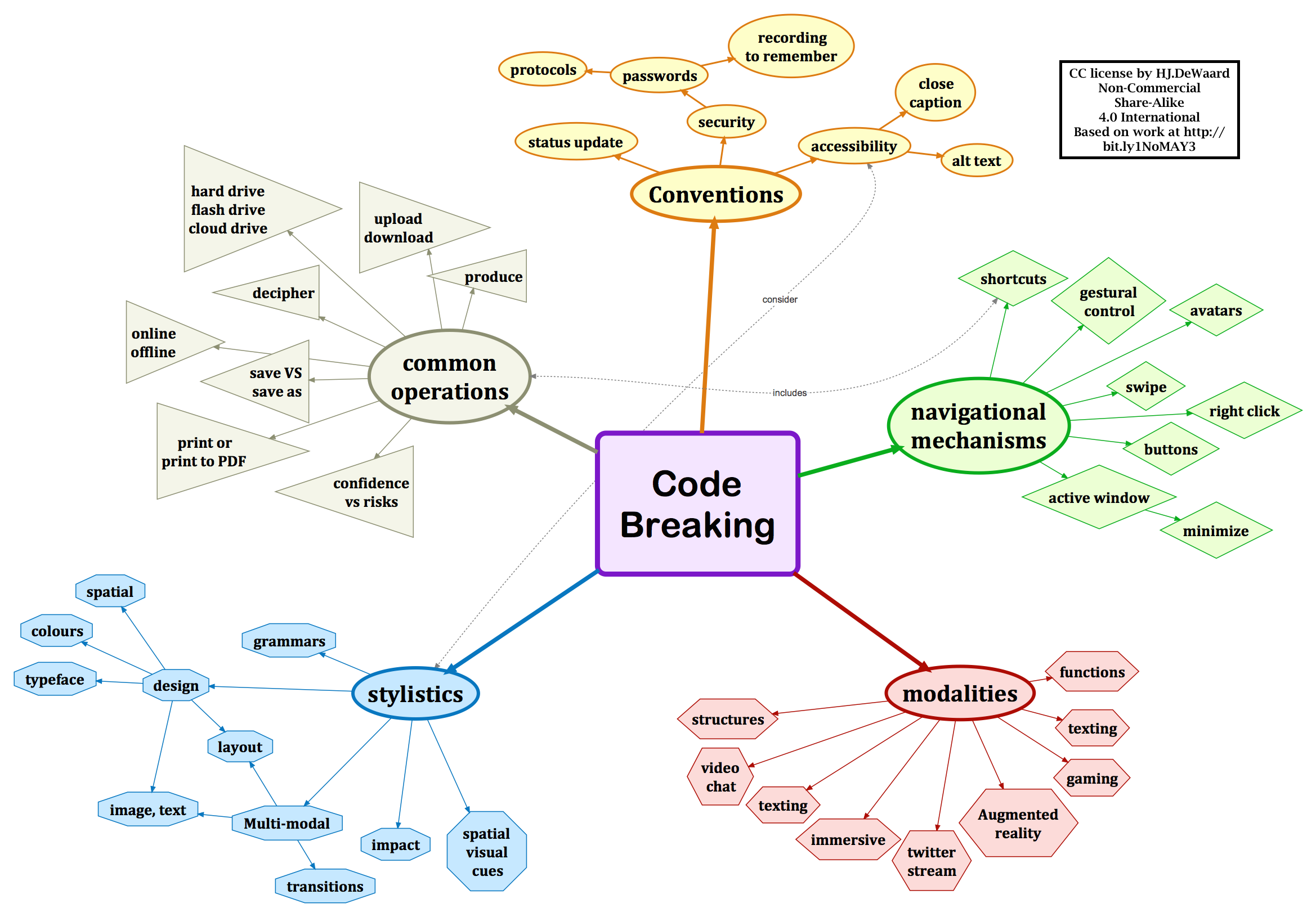
The different components of codebreaking struck me when I first saw the graph of the parts spread out main categories and branched off of that. These components I have always overlooked and never thought of the conventions of different digital texts. For example the difference between a double of single tap to view information of like a post on Instagram.

References
Hinrichsen, Juliet & Coombs, Anthony. (2013). The Five Resources of Critical Digital Literacy: A Framework for Curriculum Integration. Research in Learning Technology, volume 21. DOI: 10.3402/rlt.v21.21334
Comments
Post a Comment